
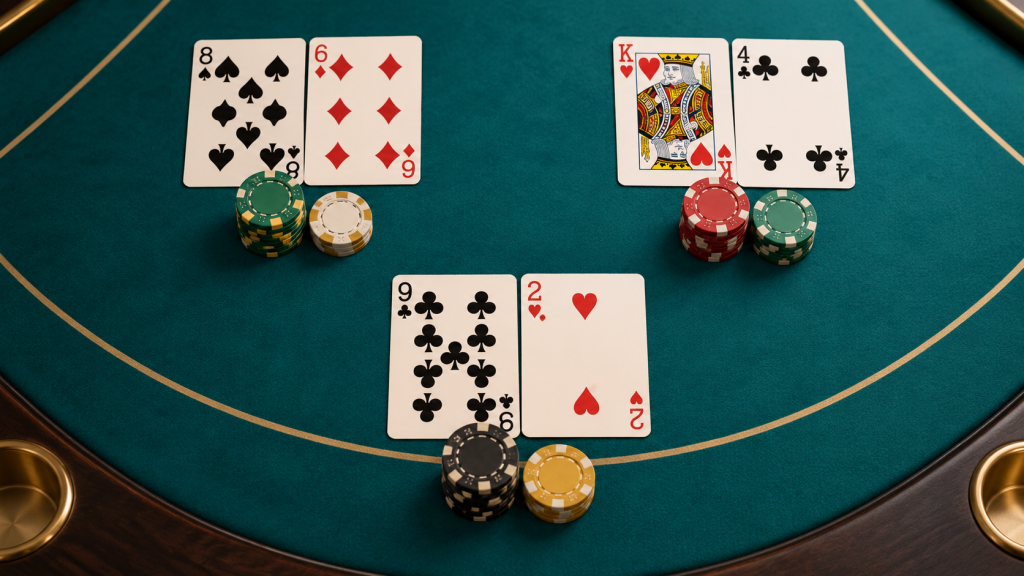
Baccarat à Deux Tableaux is often translated as two-table baccarat. The name describes two player sides, each with its own shared hand, facing the same banker.
For readers exploring the format through hawkplay content, the key is to follow three hands instead of two. The table may have several participants, but each player group is represented by one hand in the round.
Understand the Three Playing Areas
| Area | Function | Opponent |
|---|---|---|
| Right player side | Represents wagers assigned to that player hand | Banker |
| Left player side | Represents wagers assigned to that player hand | Banker |
| Banker | Uses one hand against both groups | Each player side separately |
Two physical tables joined together are not a universal requirement. What matters is the two-sided playing arrangement and the separate comparisons.
Participants do not each receive a private hand to play against everyone else. The active representative handles the shared hand for the relevant side under the table’s procedures.
Follow the Opening Deal
In the traditional sequence, a card goes to the right player side, then the left player side, then the banker. The sequence repeats, giving each hand two cards.
Each hand is scored using baccarat values: Aces count one, cards 2–9 count at face value, and tens and picture cards count zero. Only the final digit of the total is used.
An initial eight or nine is a natural. If a natural is declared, the hands are exposed and the appropriate settlements follow. Otherwise, the two player hands act before the banker.
Each Side Makes Its Own Drawing Decision
One side may have three points and need a card, while the other holds seven and stands. A hand on five has the traditional choice to draw or stand.
This separate action is what makes the two-table structure useful to understand. A hawkplay reader should not expect both player sides to receive identical treatment simply because they are facing the same bank.
The banker then chooses whether to draw using the available information from both sides. One completed banker hand is still used for both comparisons.
Read a Completed Round
| Final right hand | Final left hand | Final banker hand | Right-side result | Left-side result |
|---|---|---|---|---|
| 5 | 8 | 7 | Loses | Wins |
| 7 | 4 | 7 | Pushes | Loses |
| 9 | 6 | 5 | Wins | Wins |
| 2 | 3 | 6 | Loses | Loses |
These examples show final comparisons, not predictions about the next round. A record of previous results does not ensure a particular result will occur next.
Can a Stake Be Split Between Both Hands?
Some rule sets permit an à cheval wager, dividing a stake equally across both player hands. Others restrict participants to their own side. Check the local rule before assuming a split is available.
Splitting does not guarantee protection. If both player hands lose, both portions lose. This is an important qualification for any hawkplay explanation of covering two sides.
What Should You Confirm Before Playing?
Identify the active player procedure, which hands may accept your wager, the bank’s coverage limit and any charges. A tied comparison normally returns the relevant stake, but a separately paid Tie market is not universal.
Use this hawkplay overview as a table-reading reference. Understanding where a wager belongs is more useful than relying on the game’s name alone.