
Wild duplication gives Ninja Raccoon Frenzy its most recognizable base-game interaction. A symbol landing in one field can influence the other through a mirrored copy, while cascades allow the board to be evaluated again. This hawkplay feature guide examines those connections before turning to the separate bonus round.
The important detail is that the grids are linked by features but remain separate winning fields. Understanding that structure prevents confusion about where matches begin and how a sequence develops.
The Center Line Explains Wild Duplication
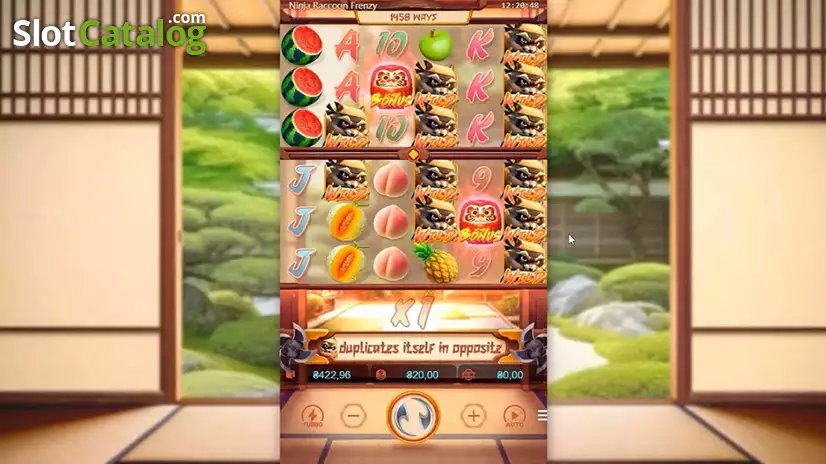
The game displays two six-reel, three-row grids, one above the other. A Wild on the upper grid is copied into a reflected position on the lower grid. A Wild on the lower grid can do the reverse.
Think of the central divider as the reference for the reflection. “The same position” is incomplete wording because the copy appears on the opposite side of that divider, rather than simply occupying an identical screen coordinate.
| Feature detail | Practical meaning |
|---|---|
| Upper-grid Wild | Can produce a mirrored copy below the divider |
| Lower-grid Wild | Can produce a mirrored copy above the divider |
| Separate grids | Each field still needs its own qualifying match |
| Result | A copied Wild may help, but does not guarantee a win |
Why a Wild Does Not Automatically Pay
Regular wins start on the leftmost reel and continue through consecutive reels within one grid. A copied Wild is useful only when the resulting arrangement satisfies the game’s winning rules.
A dramatic Wild animation can therefore be followed by no qualifying payout. The animation shows that the feature occurred; it does not override the need for a valid symbol combination.
For hawkplay readers reviewing the board, start at reel one and follow the matching symbols to the right. That approach is more reliable than looking only at the location of the Wild.
Cascades Create Further Evaluations
Once a combination pays, its winning symbols disappear. Replacement symbols fall into the gaps, creating a new arrangement that may contain another match. A paid spin can consequently contain several payout stages.
The base-game win multiplier begins at 1×. It increases by one after a winning round resolves into a cascade, so a later qualifying win can receive a larger multiplier. The progression belongs to that spin sequence and restarts with a new paid spin.
| Example stage | Applicable idea |
|---|---|
| First winning evaluation | Starts from the 1× base-game multiplier |
| Replacement symbols arrive | The next evaluation may form another win |
| Further successful evaluation | Uses the increased multiplier |
| Sequence ends | Further payouts are not guaranteed |
This is a sequence of conditional events. A cascade creates another arrangement, not a promise that the arrangement must win. Similarly, an increased multiplier only has an effect when there is a qualifying award to multiply.
Base-Game Multipliers and Bonus Prizes Are Different
The word “multiplier” appears in both parts of the game, but it does not always describe the same operation. During the base game, the win multiplier applies to qualifying symbol wins. During the bonus, prize symbols display values relative to the stake.
This hawkplay comparison keeps the terminology clear.
| Mechanic | Where it appears | Main role |
|---|---|---|
| Win multiplier | Base-game cascade sequence | Increases qualifying awards |
| Prize Multiplier symbol | Bonus feature | Displays a prize value in bet multiples |
| Increasing prize | Bonus feature | Gains value on later bonus spins |
| Shuriken or Kunai | Bonus feature | Collects or adds to prize values |
The Supporting Game Statistics
Across the two grids, Ninja Raccoon Frenzy has 1,458 ways. Its reference RTP is 96.81%, and its advertised maximum win is 2,500× the bet. The visual relationship between grids should not be used to infer that the probability of winning has doubled.
The bonus starts with three or more Bonus symbols. It then uses prize values, mirrored growth positions and weapon modifiers instead of the ordinary fruit-matching sequence.
Wild and Cascade Questions
Can one combination cross both grids?
The grids are separate winning fields. Wild duplication connects their behavior without creating one twelve-reel combination.
Does every cascade pay?
No. Replacement symbols must form another qualifying match.
Can this feature be forced by changing the stake?
There is no rule described here that lets a stake change force a Wild or a winning cascade. This hawkplay explanation concerns how results are evaluated, rather than a method for controlling them.